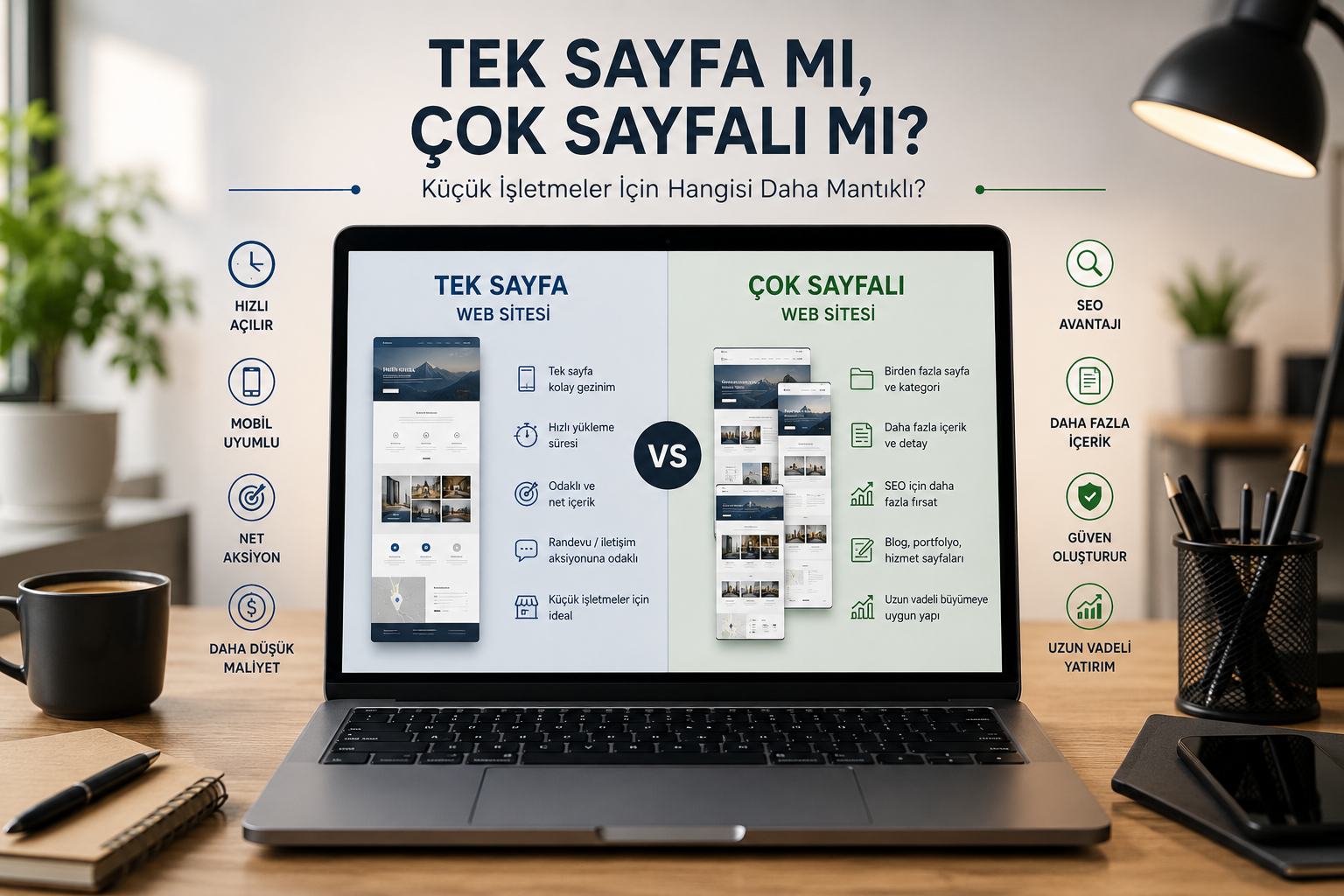
When a small business decides to get a website, one of the first questions is usually simple: should the website be one page or multiple pages?
There is no single correct answer for every business. A cafe, barber shop, beauty salon, personal brand, course center, or local service provider may need different structures depending on its goals, content, and customer journey.
The important point is not choosing the bigger option. The important point is choosing the structure that helps visitors understand the business quickly and take the right action.
What is a one-page website?
A one-page website presents all important information on a single page. Instead of moving between different pages, visitors scroll through sections such as introduction, services, gallery, testimonials, location, and contact.
This structure works well when the business has a clear offer and does not need too much detailed content.
For example, a local cafe may use a one-page website to show its concept, menu highlights, atmosphere, location, opening hours, and contact options. A barber shop may use the same structure to present services, prices, photos, and appointment actions.
When is a one-page website enough?
A one-page website can be a good choice when the business needs a simple, fast, and focused online presence.
It is especially useful when:
- The business has a limited number of services
- The main goal is to receive calls, WhatsApp messages, or visits
- The content can be explained clearly without separate pages
- The website needs to be launched quickly
- The visitor journey should be short and direct
For many local businesses, a well-designed one-page website can be more effective than a complicated multi-page website. If customers mainly need your location, services, opening hours, and contact information, one page may be enough.
What is a multi-page website?
A multi-page website separates information into different pages. For example, it may include Home, About, Services, Projects, Blog, Contact, and other specific pages.
This structure is useful when a business has more information to explain or wants to build stronger search engine visibility over time.
A multi-page website gives each topic its own space. This can make the website easier to organize and more suitable for businesses that want to grow their content.
When is a multi-page website better?
A multi-page website is usually better when the business needs more depth, more content, or more SEO opportunities.
It may be the right choice when:
- The business has many different services
- Each service needs its own explanation
- The business wants to publish blog content
- There are projects, references, or case studies to show
- The website needs to target different Google searches
- The brand needs a more complete and professional online presence
For example, an education center may need separate pages for programs, instructors, frequently asked questions, and contact. A web design service may need separate pages for services, projects, blog posts, and portfolio examples.
Which one is better for SEO?
In general, a multi-page website has more SEO potential because each page can target a specific topic or keyword.
For example, a business can have separate pages for “website design,” “website redesign,” “WordPress setup,” or “landing page design.” This makes it easier to explain each service clearly and gives search engines more structured content to understand.
However, this does not mean that every business must start with a multi-page website. A weak multi-page website with thin content is not better than a strong one-page website.
Quality matters more than page count.
Which one is better for local businesses?
For many local businesses, the best starting point is often a strong one-page website.
A one-page website can clearly present:
- Who the business is
- What it offers
- Where it is located
- How customers can contact it
- Why visitors should choose it
This is usually enough for cafes, barber shops, salons, small studios, and many service-based businesses that mainly want to increase trust and make contact easier.
Later, the website can grow into a multi-page structure if the business needs more content, blog posts, service pages, or portfolio sections.
My practical recommendation
If you are just starting and need a clean online presence quickly, a one-page website may be the smarter choice.
If your business has multiple services, long-term SEO goals, blog plans, or portfolio content, then a multi-page website will usually be more suitable.
The decision should be based on your business goal, not on what sounds more impressive.
Conclusion
A one-page website is simple, focused, and fast to launch. A multi-page website is more flexible, more detailed, and usually stronger for long-term SEO.
For small businesses, the best website structure is the one that helps customers understand the business and take action without confusion.
If you are not sure whether your business needs a one-page website or a multi-page website, we can plan the right structure based on your services, goals, and target customers.